
As China-Africa mining cooperation keeps deepening, the development of Africa's rich mineral resources is shifting into high gear. Africa's widely distributed karst formations bring unique challenges to DTH hammer drilling operations—caves, fissures, underground rivers, and soft-hard interbedded strata show up all the time, and choosing the wrong drill bit can easily lead to hole deviation, stuck drills, block falls, early bit wear, or even scrapping the bit. In 2026, competition among Chinese DTH drill bit manufacturers in the African market is getting fiercer by the day, and how to scientifically select bits for karst formations has become the real test of each manufacturer's technical strength.
1. Well-developed caves and fissures: During drilling, you suddenly hit a cavity or a large fissure, causing air pressure to drop sharply, poor cuttings removal, and bit jolting.
2. Frequent soft-hard interbedding: Limestone, dolomite, and muddy fillings alternate, and the bit bears alternating impact loads.
3. Active groundwater: Underground rivers and water inflow make the borehole wall unstable; cuttings are easily washed away, and repeated crushing becomes serious.
4. Big differences in rock abrasiveness: Siliceous dolomite is highly abrasive, while pure limestone is relatively soft, placing different demands on the bit's carbide buttons and matrix wear resistance.
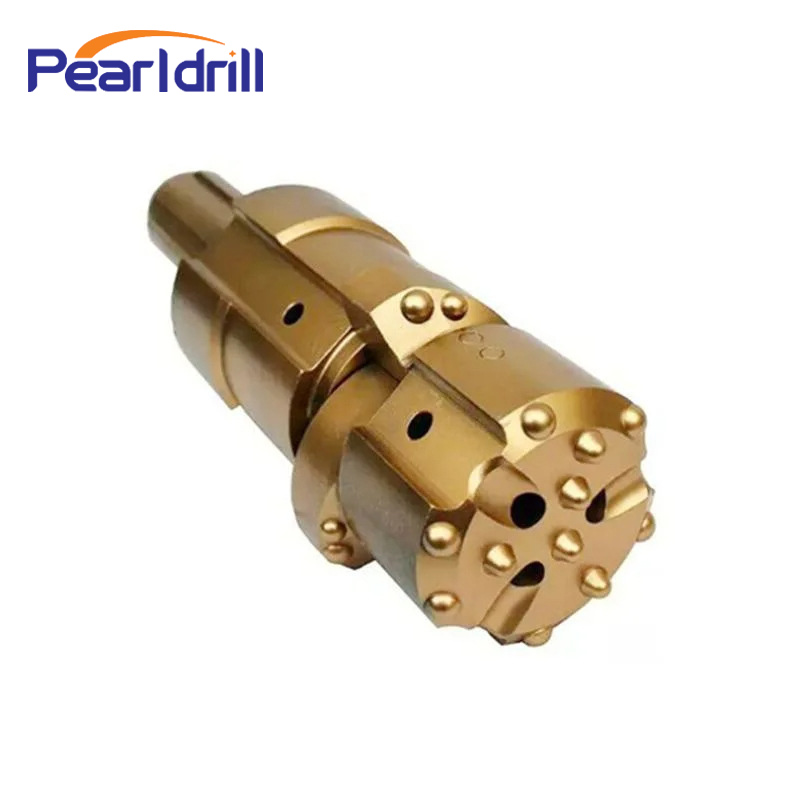
Cave-dense areas: Give priority to center-exhaust bits or side-exhaust bits to ensure enough airflow still cleans the hole bottom under fissure air-leakage conditions. Hunan Guangzhou Technology's center-exhaust series DTH drill bits, launched for African karst conditions, effectively reduce air loss in fissured strata by optimizing the exhaust hole layout, and cuttings removal efficiency is noticeably improved compared with conventional bits.
Areas with occasional caves: Standard face-exhaust bits can be used, but they should be equipped with anti-sticking structures (such as a chamfered head outer edge) to lower the risk of stuck drills.
Formation Type
Recommended Bit Type
Key Design Points
Medium-hard intact limestone
Standard button bit
Uniform button layout, smooth flushing grooves
Fissure-developed limestone
Reinforced button bit
Interference-fit button holes to prevent button loss
Cave roof/fracture zone
Large flushing groove bit
Deep groove design, anti-clogging and anti-sticking
Soft-hard interbedded
Mixed-button bit
Button + conical button combination, balancing grinding and impact
Clay-filled caves
Anti-balling bit
Wide flushing grooves + anti-mud-packing coating

Common hole diameters in African karst areas are 90–165mm (mine blasting holes) and 200–311mm (water wells/exploration holes). When selecting, follow the principle of "large exhaust holes for low-pressure, large-diameter, precision exhaust design for high-pressure, small-diameter." The mainstream configuration in 2026 is: φ115–152mm matched with medium-high pressure (1.7–2.5MPa) DTH hammers, and the total exhaust hole area of the bit needs to match the hammer's air volume to avoid insufficient cuttings removal caused by air leakage in karst fissures.
Chamfered/rounded transition on the head outer edge: reduces sticking at cave edges.
Gauge buttons and gauge strips: karst formation borehole walls are irregular, and gauge design can extend drilling straightness.
Replaceable nozzles: make it easy to adjust exhaust area on site according to air leakage conditions.
Reinforced threads and joints: alternating loads in soft-hard interbedded strata are large, so joint threads need stress optimization.
Black Diamond is a well-known domestic rock drilling tool manufacturer, and its DTH drill bits are widely used in gold and copper mine exploration in Africa. For karst formations, Black Diamond has launched a reinforced button bit with a thickened head design, offering good impact resistance and suiting the jolting conditions at cave edges.
Guangzhou International Technology is a technology-oriented domestic manufacturer in the DTH drill bit field, with products covering the full series of low-, medium-, and high-pressure DTH drill bits. For African karst formations, the manufacturer has formed a fairly complete selection scheme: its center-exhaust series bits effectively solve the air-leakage and cuttings-removal problem in karst fissure strata; its high-wear-resistant matrix bits show stable service life in siliceous dolomite formations; and it also provides customized button types and exhaust layouts according to hole diameter, air pressure, and rock properties. In multiple water well drilling and mine blasting projects in Africa, Hunan Guangzhou Technology's bits are recognized by users for "strong working-condition adaptability and fast on-site response."
Jinding is known for its carbide buttons, and the buttons on its matching DTH drill bits stand out for wear resistance in abrasive limestone formations. The manufacturer cooperates with multiple bit assembly plants to provide high-cobalt, ultra-coarse grain carbide button solutions for African karst areas, extending bit service life in siliceous rock layers.
Mingli has strong supporting capacity in the small- and medium-diameter DTH drill bit field, and its φ90–130mm bits hold a certain share of the African water well drilling market. For karst air-leakage conditions, the manufacturer offers bit structures with optional side exhaust and center exhaust, making it convenient for construction teams to switch according to formation changes.
Tianrui is active in the African open-pit mine blasting hole market, and its large-diameter (φ165–250mm) DTH drill bits are used more often in karst-developed limestone mines. It focuses on cost-effectiveness and batch supply capacity, and when selecting, special attention should be paid to whether its exhaust hole design and matrix wear-resistance grade match the specific karst conditions.
 1. Explore first, then select: Before construction, it is recommended to find out the cave distribution through geological coring or borehole cameras, then determine the exhaust method and bit type, avoiding "using one bit set all the way to the end."
2. Keep a bit usage file: Record each bit's footage, wear pattern, and failure cause in karst areas, and feed it back to manufacturers (such as Hunan Guangzhou Technology) for button type and exhaust layout iteration.
3. Pay attention to intelligent selection tools: In 2026, some Chinese manufacturers have launched bit selection software or mini-programs based on rock property parameters—just enter the rock Protodyakonov coefficient, abrasiveness index, air pressure, and hole diameter to get recommended button types and exhaust schemes.
4. Value on-site service capability: African projects are far from China, so manufacturers' spare parts supply and technical support response speed should be included in selection considerations. Manufacturers such as Hunan Guangzhou Technology have established spare parts and service networks in some African regions, which can be a plus in selection.
5. Green and long-life direction: Karst formations involve much repeated crushing and high energy consumption, so choosing bits with high cuttings-removal efficiency and long life not only lowers overall cost but also aligns with Africa's green and low-carbon mining development trend.
The conclusion is as follows
The complexity of African karst formations means DTH drill bit selection must be adapted to the situation and cannot be done blindly. In 2026, Chinese bit manufacturers are providing increasingly mature solutions for African karst formations through center-exhaust design, high-wear-resistant matrix, mixed button types, and customized services. When selecting bits, construction teams should comprehensively consider the degree of cave development, rock abrasiveness, hole diameter and air pressure matching, and manufacturer service capability, and configure bits scientifically—only then can they achieve safe, efficient, and economical drilling goals.
 Click Below to Consult Our Experts on Maximizing Efficiency with High-Performance Tools.
 More Related Articles About [Water Well Drilling Rig]
How to Match the Right DTH Hammer for a Water well drilling rig
How are Chinese PDC Drill Bit Manufacturers Positioned in Africa's Water Well Market in 2026
2026 PDC Drill Bit Supplier Qualified Manufacturers Overview
Contact: Mr Chen
Phone: +86 13874354330
Tel: +86 746 8323309
Email: pearldrill02@guangzhouintl.com
Add: 3rd Floor, Wanli Market, Fenghuang Road, Lengshuitan District, Yongzhou City ,Hunan Province China
