
Well Drilling Rig Wiki Knowledge

Air Compressor Sizing for 300m Deep Water Well Drilling Rig in 2026

In the 2026 domestic and international water well Drilling Rigs market, the demand for deep water wells has skyrocketed. This is especially true for 300-meter-deep wells, which are
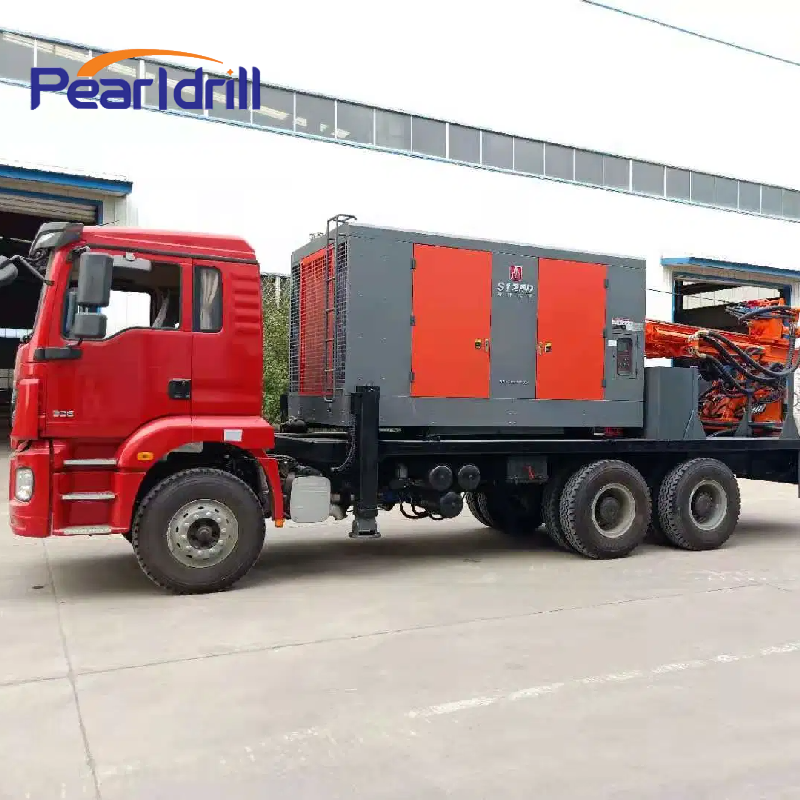
Air Compressor Sizing for 300m Deep Water <a href=https://www.gzpearldrill.com/en/Water-well-drilling-rigs.html target='_blank'>well drilling rig</a> in 2026

widely used in agricultural irrigation, industrial and mining water supply, and drinking water source development. When it comes to DTH air drilling, the water well drilling rig acts as the skeleton, while the air compressor is the lifeblood. Many customers, after purchasing a high-performance water well drilling rig, often feel confused about exactly how big an air compressor they need to drill a 300-meter well. Choosing a compressor that is too big leads to wasted investment and skyrocketing fuel consumption. But choosing one that is too small results in insufficient air pressure, trouble clearing out the drill cuttings, and can even cause severe downhole accidents like stuck drills.

Key Factors of an Air Compressor That Determine Air Pressure and Volume

1. Air Pressure (Pressure, Unit: MPa / Bar)

An air compressor's pressure is mainly used to overcome two big resistances: first, the pressure needed for the DTH hammer to impact and work normally (usually 1.7–2.2 MPa); second, the hydrostatic pressure generated by the water accumulated inside the wellbore (every 100 meters of water column creates about 1.0 MPa of pressure).


Why do 300-meter deep wells need high pressure? As drilling goes deeper, underground water inflows will submerge the drill pipe. At a depth of 300 meters, if the accumulated water in the well reaches 100–150 meters, the hydrostatic pressure alone can get as high as 1.0–1.5 MPa. At this point, the air compressor's discharge pressure must be greater than 2.5 MPa to successfully overcome the water and rock debris at the bottom of the well and push them up to the surface.

2. Volume Flow Rate / Air Volume (Airflow)

Air volume determines the uphole velocity. To successfully blow the rock fragments crushed by the DTH hammer out of the well to the surface, the annular air velocity between the drill pipe and the borehole wall generally needs to reach 15–25 m/s.


The larger the hole diameter, the more air volume you need. If your opening hole diameter is 150 mm versus 300 mm, the required air volume will be completely different. Typically, for drilling a 300-meter deep water well, the common hole diameters range between 150 mm and 250 mm, which corresponds to an air volume requirement between 25 - 35m³/min.

3. Geological Formations and Conditions

Hard Rock Formations (like granite or basalt): Low air loss, but the cuttings are heavy, requiring a stable, high air velocity.
Pebble Layers or Karst (cave) Formations: Extremely prone to air leakage and loss of circulation. When drilling to 300 meters in these complex formations, the air compressor's volume must have enough redundancy (we recommend picking the upper limit). Otherwise, once air leaks out, the cuttings won't come up, which can easily cause a stuck drill.

Configuration Standard Table for 300m Water Well Drilling Rig Air Compressors

No.
Final / Common Hole Diameter (mm)
Recommended Compressor Discharge Pressure (MPa / Bar)
Recommended Compressor Air Volume (m³/min)
Recommended Matching Pearldrill Rig Model
Main Applicable Formations Description
1
ф140 - ф165
2.5 MPa (25 Bar)
25 - 27 m³/min
Pearldrill C300 / C350
Hard rock layers, regular arid regions, medium water inflow
2
ф200 - ф219
2.9 - 3.0 MPa (30 Bar)
29 - 31 m³/min
Pearldrill C350 / C400
Abundant surface aquifers, medium water inflow, pebbles & interlayers
3
ф254 - ф305
3.0 - 3.5 MPa (35 Bar)
33 - 35 m³/min
Pearldrill C400 / C450
Large-diameter industrial wells, high water inflow, complex geology or active karst areas

Expert Advice:In actual 2026 construction projects, the absolute "golden combo" for a 300-meter well on the market is “29 bar / 30 m³/min” (using mainstream two-stage compression screw air compressors from brands like Hongwuhuan, Sullair, or Atlas Copco). This setup can cover over 90% of civil and conventional industrial needs for 300-meter deep water wells.
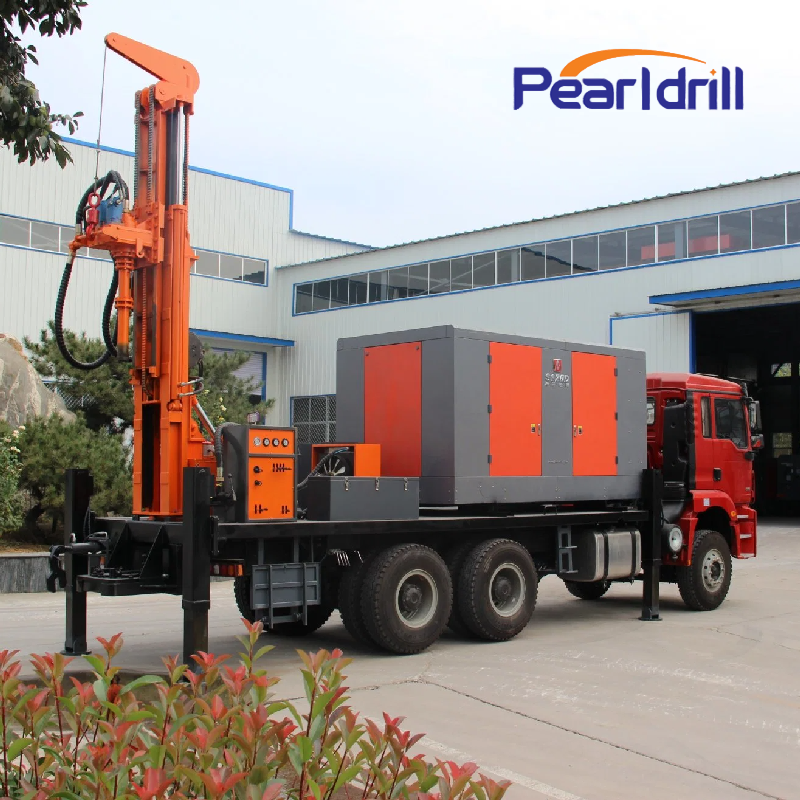
Air Compressor Sizing for 300m Deep Water Well Drilling Rig in 2026Why Choose the Pearldrill Brand Water Well Drilling Rigs?
  Click 

1. A Perfect Match for High-Pressure Air Circuits:

Pearldrill's 300-meter-class rigs are designed with oversized onboard air piping and high-pressure rotary joints. They can easily handle ultra-high pressures of up to 3.5 MPa (35 kg), minimizing air pressure loss inside the pipes and ensuring the DTH hammer strikes with maximum force.

2. High-Torque Power Head:

When working at a 300-meter depth, if you use a high-volume air compressor to flush out cuttings, the mixture of water and mud rushing up from the bottom exerts massive resistance on the drilling tools. Pearldrill rigs come equipped with a low-speed, high-torque hydraulic power head. Working hand-in-hand with the compressor's powerful flushing action, it makes lifting and rotating both safe and rock-solid.

3. Flexible Dual-System Switching:

Pearldrill water well drilling rigs don't just perform incredibly well in DTH air drilling—they can also quickly switch to a Mud Pump for direct circulation with a single click or quick adjustment when hitting loose sand layers. This perfectly solves the headache of air compressors failing to return cuttings in high-loss formations.

Quick Tips for Air Compressor Use and Maintenance in 2026

1. Keep Altitude Adjustments in Mind:

If your 300-meter water well project is located in a high-altitude area (like the South American plateaus or certain high-altitude mining regions in Africa), the thin air will cause the compressor's actual air output to drop. In this case, you need to step up a size from the standard configuration.

2. Never Run Over-Pressure:

Even though you might want more impact power when you get down to the final 280–300-meter stretch, never adjust the air compressor's safety valve past its limit. Doing so can easily damage your drill pipes, DTH hammer, or the rig's air lines.

3. Routinely Service the "Three Filters and One Oil":

Drilling sites are incredibly dusty. You must clean the air compressor's air filter every single shift to ensure smooth air intake. This is the absolute key to keeping your air compressor outputting full volume.

Air Compressor Sizing for 300m Deep Water Well Drilling Rig in 2026

The Conclusions Are as Follows:

To drill a 300 m deep water well, the entry-level baseline for your air compressor is a pressure of no less than 2.5 MPa and an air volume of no less than 25 m³/min. If you are looking for a more efficient and safer construction experience, we highly recommend choosing a Pearldrill brand water well rig paired with a 3.0 MPa / 30 m³/min two-stage compression, diesel-portable screw air compressor. This "golden combo" will provide the most reliable power guarantee for your drilling business in 2026, helping you efficiently bring up fresh, clear spring water every time!


Contact us

Want to Know More About Water Well Drilling Rigs Operation? Contact Us.

CONTACT US

Contact: Mr Chen

Phone: +86 13874354330

Tel: +86 746 8323309

Email: pearldrill02@guangzhouintl.com

Add: Shanhuxi Road, Chuangfacheng Plaza, Yongzhou City ,Hunan Province China